
|
07.02.2026
14:20 Uhr
|
After the mid-January vote, Ugandan musician and opposition leader Bobi Wine fled the forces of his rival, ruler Yoweri Museveni. From hiding, he still speaks out.
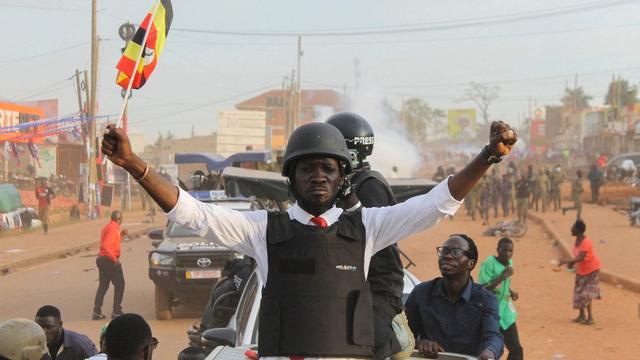
Read this text in German. At the end of the interview with Bobi Wine, which he conducts from a hideout off-the-map in Uganda, he does what brought him his initial fame: he sings. "One day, everything is gonna be fine." His voice is shaky, his soft laughter sounds bitter. Bobi Wine, one of the most popular musicians in East Africa and more recently one of the most popular politicians in his own country, is wanted and has gone into hiding. He is on the run from Uganda’s police and armed forces, whose higher-ups have already threatened him on social media with diverse punishments including beheading and castration. Several weeks ago, in January, Uganda's strongman Yoweri Museveni secured a seventh consecutive term in office. He claims that he garnered over 70 percent of the vote while his foremost opponent, Bobi Wine, took just 25 percent. During the campaign, Wine's rallies were systematically disrupted, his supporters beaten, and several were even killed. And, finally, the entire country’s internet was shut down. The night after the vote, police and soldiers stormed the opposition leader’s house. He managed to escape – and is now in hiding. Die Zeit tried again and again to contact him. Too dangerous, his friends explained; an interview with journalists might enable authorities to trace his location. Then, on the evening of February 3, we finally talked to him by phone: one of the rare occasions since his disappearance that Wine has dared to speak to the media. DIE ZEIT: How are you? Bobi Wine: I am alive. And I want to stay alive as long as possible. ZEIT: Apparently, soldiers are in your house. They’re searching for you. Wine: I haven’t broken any laws. Running for president is not a crime. ZEIT: On X, a general has threatened you with torture or death. Wine: I know—and I take that seriously. For the time being, Bobi Wine is on the run. Sought by Ugandan authorities, barely able to communicate, invisible to his supporters: this is a low point in the life of a man who tens of thousands celebrated during the campaign. Many young people in Uganda – and throughout eastern Africa – had put their hopes in him. Wine, 43 years old – his born name is Robert Kyagulanyi Ssentamu – grew up in a slum in Kampala, the capital, and had his first hit songs at the age of 19: initially about parties, fast cars, and pretty girls; then about corruption, rising prices, and police violence. In 2017, his first stab at politics landed him in parliament. His supporters still call him the "ghetto president." In 2021, he dared to challenge Museveni for the presidency. Wine officially received 35 percent of the vote, but unofficially the figure was probably much higher. More than three quarters of Uganda's approximately 50 million people are younger than 40. They have never known a head of state other than Museveni. He came to power in 1986 as the leader of a rebel movement. As one of the African reformers of the 1980s, he was initially popular. Today, at 81, he heads a political elite in which family members divvy up posts and privileges between themselves. The top general, Muhoozi Kainerugaba, is Museveni's son and likely his successor, too. Last year, Kainerugaba made headlines when he publicly claimed that he was torturing Wine’s bodyguard and close friend in his own basement after the man had been arrested. ZEIT: A few days ago, there were media reports that soldiers allegedly assaulted your wife in your home. Do you know how she is doing? Wine: I don't know. All I know is that she had to be taken to the hospital and is now also in hiding. Bobi Wine had clashed with Kainerugaba before, in 2022. At the time, the president's son was celebrating Russia's full invasion of Ukraine on X – in the name of "the majority of humanity (which is not white)." Wine traveled to Kyiv and Bucha shortly thereafter to commemorate the victims of the Russian massacre there. He explained to his fellow Ugandans that this war in distant Europe was exactly the kind of colonial aggression that Africans had suffered so often in their history. ZEIT: You’ve been to Europe many times and have been honored with human rights commendations. Are European countries supporting you now? Wine: It's hard to say. I have to be extremely careful and find it difficult to communicate. But I’m very disappointed that there is almost no international criticism of Museveni's regime and these elections. My supporters and I do not recognize the outcome. This election was stolen.